Showing posts with label nancee. Show all posts

Sunday, July 10, 2011

Cold Wind

Cold Wind by C.J. Box

Cold Wind is one of C.J. Box's best -- with more twists and turns than any of the others. I couldn't wait to finish this one. Joe Pickett discovers the body of his mother-in-law's husband and soon after his mother-in-law, Missy, is accused of the murder. Despite the animosity between Missy and Joe, Joe's wife convinces him he must work to clear her of the accusation. As with other Joe Pickett novels, this one combines a detailed but well-developed plot; dry, Western humor and twists and turns that leave the reader/listener unable to stop reading until the last page is finished.

This was the first Box title I have listened to; narrator David Chandler didn't quite pull off the role of game warden Joe Pickett as well as I would have liked and I found his narration of female characters somewhat annoying. But that's okay -- as long as Box keeps writing Joe Pickett mysteries, I'll keep reading them. And occasionally listening to them.

Grounded


Grounded by Kate Klise, 208 pages


"I'm alive today because I was grounded." So starts 12-year-old Daralynn's story of why she remains alive after her father, sister and brother were killed when a plane piloted by her father crashed. The loss has transformed her mother into a bitter, angry woman who begins her own business as a hair stylist for the local funeral home after everyone admires the wonderful job she's done on her children and husband for their funerals. When Mr. Clem, a stranger with plans to build a crematorium, appears in town, the funeral home's continued success -- and Mother's job there -- is threatened, and Daralynn decides to take action. Her idea to host "living funerals" is successful, but only results in more competition for the funeral home and a growing distrust of Mr. Clem, who is as successful at courting Daralynn's aunt as he is in convincing the town folk that cremation is the wave of the future.

Daralynn's voice is wonderful and convincing, and Klise's setting and storytelling are reminiscent of Richard Peck's wonderful books about small towns and the characters who populate them. I loved this book and read it in one setting. Klise has created a fully-formed town, charming and engaging characters and a story full of humor, mystery and good, old-fashioned storytelling. For a book about the death of one young girl's parent and siblings, Klise manages to keep the reader engaged in Daralynn's loneliness, development and growth with humor and wit. I think this is Klise's best book so far, and I recommend it to anyone who enjoys storytelling on par with "A Long Way from Chicago" and "Moon Over Manifest."
flag

The Absolute Value of Mike

The Absolute Value of Mike by Kathryn Erskine, 256 pages


I loved this book -- I think maybe even more than "The Mockingbirds," but then again, it's almost like comparing apples and oranges, so I won't. Erskine's writing is just as good here, though, as with her last book, and she again manages to make readers fall in love with the quirky characters and humorous plot. I have read three really terrific middle grade novels in a row, each with three similar characteristics -- warm, small town settings filled with quirky characters, laugh-out-loud stories and children finding guidance, love and friendship from people around them.
flag

Monday, February 28, 2011

The Strange Case of Origami Yoda

by Tom Angleberger. 141 pages.

Tommy and his friends face the usual dilemmas facing many sixth graders: the opposite sex, parents, school, the opposite sex, friends, sports and the opposite sex.

Enter Dwight, who rarely does anything right, is always in trouble, gets harassed by other kids and picks his nose. And who is also an origami master. Dwight is the creator and voice of Origami Yoda, a paper puppet. Yoda gives cryptic, very Jedi-like advice to Tommy and all his friends, including Mike, who is driven so insane when playing softball in PE it makes him cry, and Quavondo, who wants to lose his nickname of 'Cheeto Hog.' But Tommy needs to know -- is Origami Yoda real? Can a loser like Dwight, who isn't even smart enough to take Yoda's advice, be the voice of Yoda? To learn if Yoda is real, Tommy's solution is to take a scientific approach -- collect stories from all of his friends and acquaintances into a case file, acquire comments from a confirmed Origami Yoda non-believer, and study the evidence. Because Tommy needs to know the answer -- if he takes Yoda's advice and it's wrong, Tommy is DOOMED.

This is such a fun book to read. Tommy, Sara, Kellen, Lance, even Dwight and Harvey are such believable and relatable characters. All of them remind me of kids I knew in middle school -- Dwight is Jeff Jacoby reincarnated! Middle-schoolers will relate to these very real, very likable characters and be fighting to follow Angleberger's Yoda-folding directions and struggling to provide Jedi-warrior advice.

Sunday, February 27, 2011

I Wanna New Room

Karen Kaufman Orloff. Illustrated by David Catrow. 32 pages.
From the creators of "I Wanna Iguana" comes a new chapter in the life of Alex. Written as a series of letters between Alex, his mother and his father, Alex explains all the reasons why he should not have to share a room with his brother Ethan now that baby Annie has arrived -- when Ethan sleeps, it sounds like a cat coughing up fur balls, he sticks crayons up his nose and he breaks Alex's toys. Alex's extravagant pleadings are met with sensible responses from his parents, until Dad hits upon the solution of the two of them building Alex his very own treehouse that he doesn't have to share with anyone (unless he starts missing his little brother).
Catrow's hilarious and detailed illustrations are the perfect complement to Alex's sly and persuasive letters. Readers will especially enjoy Catrow's bird's eye view of Alex's plans for his own wing on the house -- a young boy's dream room!

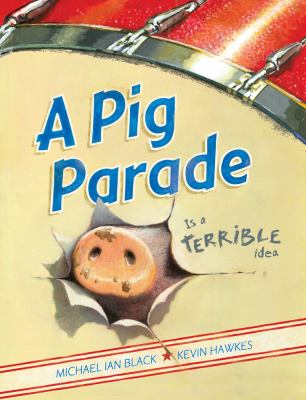
A Pig Parade Is a Terrible Idea

Michael Ian Black. Illustrated by Kevin Hawkes. 32 pages.

Pigs are irresistable. That's why they turn up so frequently in children's books. Parades are grand and spectacular affairs. So shouldn't a pig parade be fun?

Black and Hawkes begin this fun picture book with cartoon-like, instrument-playing pigs, colorfully marching across the page amidst fireworks and banners. A turn of the page yanks the reader back to a humorous reality featuring pigs rendered in sophisticated, muted acrylic colors. Pigs who snuffle (described as "walking with your nose"), refuse to wear majorette costumes and only like the kind of floats made from ice cream and root beer, which are only some of the hilarious reasons the author uses to make it "absolutely, completely and totally clear that a pig parade is a terrible idea."

The illustrations of this book work so well with the authoritative, almost academic tone Black uses to recount the inappropriate attributes of pigs in relation to parade success. The little twist at the end will make adults chuckle and young readers laugh out loud.

P.S.: The book designers had fun with the acknowledgement page!

Socksquatch

Words and pictures by Frank W. Dormer. 32 pages. Socksquatch the monster searches the castle for a sock. He has only one and his foot is cold. After a werewolf, Frankenstein and the Mummy cannot help him, the damsel comes to his rescue and supplies Socksquatch with one of her socks. Spare text and child-like illustrations make for a simple and sweet story.

This was a cute book, but it wasn't necessarily something I'd recommend. It might work well as a supporting book in a story time about socks (and how often they go missing), but the small size of the book would mean it could only be used with very small audiences.

Stomp, Dinosaur, Stomp

by Margaret Mayo, illustrated by Alex Ayliffe.

Dinosaurs stomp, zoom, whack, gulp, charge and stroll through the pages, which are filled with large, colorful cut-paper collage illustrations. A fun book to read aloud, the lengthy dinosaur names do nothing to interrupt the superb cadence:

Wrinkly Triceratops loved
charge, charge, charging,
thumpety-thump!
Huge feet pounding, horns jutting,
and -- wham! -- head-butting.
So charge, Triceratops, charge.

This will be a fun book to share at story times -- vocabulary, phonological awareness, print awareness -- all are supported, but more importantly, kids will love stomping, chanting and acting out this delightful book!

Just One Bite: 11 Animals and Their Bites at Life Size!

by Lola Schaefer. Illustrated by Geoff Waring. 32 pages.


With its large, colorful illustrations that span two-page spreads (and in the case of fold-out pages, more), this oversize picture book will fly off the shelves. Much like Steve Jenkins "Actual Size" books, Schaefer and Waring explore eleven successively larger animals and how and what they eat.


The illustrations generally provide the reader with a good sense of scale. For instance, the first two-page spread begins the journey with the common earthworm featured in a cross section of earth along with a nail, a coin, rocks and a key, as well as a small spot of brown to indicate the size of dirt the worm can consume. However, the illustrations featured on the fold-out pages might confuse some readers. Unfolding the right-hand page to discover the length of an elephant's trunk, readers must leave the spread unfolded when turning to the next page, which features the teeth of a sperm whale devouring a giant squid. The right side of this spread also opens out, so the whale's mouth takes up two unfolded double pages. The last page wraps up the exploration with a sentence about microorganisms that eventually feed on everything. The remaining unfolded portion of that page launches into more thorough examination of the eleven featured animals (and the microorganisms).

While I loved the illustrations in this picture book, the design bothered me. It is certainly a title that can be shared in preschool story time, since the text consists of about one short sentence per animal. But when the story time reader gets to the last page (with text and pictures about microorganisms) the audience will see either see the last double-page spread that features additional information, or a section of the elephant, or a section of the whale, depending on how the pages are folded. This likely won't matter to most, but I guess I'm a purest. It irritated me that I couldn't figure out how to refold the pages and make the design flow nicely.

Ling & Ting: Not Exactly the Same

by Grace Lin. 43 pages.


In six simple chapters, readers learn about Ling and Ting, twins who everyone claims are exactly the same. But Ling can sit still and Ting cannot, Ling makes neat dumplings and Ting makes fat ones, Ting eats with chopsticks and Ling prefers a fork, and Ling likes books about dogs while Ting reads fairy tales. But while these sisters, who look very much alike, are very different from one another, one thing they agree on is that they will always stay together.

A warm story perfect for new readers just starting the challenge of chapter books, this short book celebrates differences and families.

Lizards

by Nic Bishop. 48 pages.


Like his previous titles exploring some of the smallest creatures in nature, Bishop's detailed and luscious photographs are like looking through a window at the zoo and seeing lizards and their habitats in person. But better, because Bishop uses his skills to bring geckos, monitors, skinks and others to life as one would only see in nature, not in the artificial environment of captivity. Bishop shares basic facts about these reptiles, including diet, habitats, defense systems, basic reproduction and other features.

What readers will find most interesting is the variety of weird abilities many lizards have -- puffing up large enough that nothing can pull them from holes in the ground, running on water, flying from enemies, swimming beneath the desert sand and squirting blood from their eyes to foil predators.

The narrative is direct, descriptive and fun to read. Printed on colorful pages that complement the photos, the text only adds to the beauty of this book. Not one to leave budding scientists and photographers wanting, Bishop includes descriptive captions to each photograph, including each lizard's name and proportion compared to the photographed size. A two-page fold--out featuring a basilist running across a pond will wow readers. As usual, Bishop shares stories about how he captured the amazing photos. An index, bibliography and glossary help readers explore the book and learn more about these creatures that have been around since the days of the dinosaurs.

Book of Big Brothers

by Cary Fagan. Pictures by Luc Melanson. 32 pages.
The two big brothers of the narrator drop him, protect him, entertain him, tease him, conspire with him and have adventures with him. A warm and fun read about having siblings and all the ups and downs that come with getting along, not getting along and the special bond that make us family.
Great retro-style art adds to the humor and warmness of this book. A bit long for a preschool story time, but a great read aloud for grades 3 through 5.

Dirtball Pete

by Eileen Brennan. 32 pages.
Dirtball Pete is filthy. And smelly. It was a fact. But Pete's mom is determined he will be clean and shiny for his appearance as Pennsylvania in the school pageant, THE FIFTY STATES AND WHY THE'RE GREAT! Devoid of the dirt, detritus and his smelly pet ferret, Pete's mom proclaims him the handsomest Pennsylvania ever. But when the wind snatches Pete's speech out of his hand once he gets to the schoolyard, Pete has no choice but to chase it down through flower beds, a trash can and bushes. Despite his appearance (and smell), Pete makes a most positive impression on the audience, helping his family and community understand that regardless of appearance and smell, Pete is a very special boy. And that was a fact.
Brennan's simple and retro-looking art is perfect for this story and it's wonderful cadence.

Chicken Big

by Keith Graves. 32 pages.

A hilarious story about chickens and acceptance. "On a teeny little farm, in an itty-bitty coop, a very small hen laid a big, humongous egg." And so begins the story of Chicken Big. The other chickens cannot decide what he is -- an elephant? A squirrel? An umbrella? A sweater? Until, like all good picture books, Chicken Big saves the day, and the other chickens (most at least), accept him for what he is -- a chicken and part of their group of friends and family. Graves' pencil art (described as "chicken scratching") fills the pages, complemented with varying size font, dialog bubbles and signage to add to the hilarious and preposterous comments from the chickens. Storytime children will quickly chime in to the recurring warning of the smallest chicken, urging others to "Run for your lives." Adults and children alike will enjoy the droll humor of this book. A perfect storytime pick.

The Secret Cave: Discovering Lascaux

by Emily Arnold McCully. 32 pages

McCully tells the fascinating story of the 1940 discovery of the cave paintings of Lascaux. Village boys looking for adventure and treasure in World War II France venture into a tunnel that leads them to cave walls covered with hundreds of paintings and engravings sealed for about 17,000 years in the cave. McCully narrates her fictionalized recreation of this piece of archaeological history simply and eloquently, using her signature paintings to support the drama and excitement of the story. Her renditions of the cave art lend mystery and a sense of awe to the discovery these boys made. The author's note completes the story and aids readers in understanding a bit more about cave art. A bibliography is included and end papers illustrate the scope and breadth of the Lascaux Caves.

Wednesday, February 16, 2011

The Pout-Pout Fish in the Big-Big Dark


The Pout-Pout Fish in the Big-Big Dark, by Deborah Diesen. Illustrated by Dan Hanna. 32 pages

The Pout-Pout Fish is as happy as a lark.
He's fast as a sailfish.
He's strong as a shark.
He's as smart as a dolphin,
But he's scared of the dark.
In this second book about everyone's favorite mopey fish, Miss Shimmer helps Pout-Pout conquer his fear of the dark. Lush and fun illustrations complement the whimsical rhymes, making this a fun read to preschoolers.


Sunday, February 13, 2011

Divergent

Divergent, by Veronica Roth. 487 pages.

In dystopian Chicago, sixteen-year-olds take aptitude tests that help them determine what faction they will choose to live in: Abnegation (committed to selflessness), Erudite (pledged to learning and knowledge), Candor (valuing truth and honesty), Amity (seeking peace and friendship) or Dauntless (committed to bravery and fearlessness). That decision also determines where they live, who they live with, what they do -- in other words, their entire future. Children who choose factions other than those they have been raised in are generally shunned by their families -- their faction becomes their family.

At the end of her aptitude test, Beatrice (Tris) learns she is a Divergent -- having thoughts and behaviors for more than one faction -- and is promptly instructed to not breathe a word of this to anyone.

Tris is confused and intrigued by the abilities she finds she is capable of, as she explores her capacity for friendship, physical prowess, bravery and romance.

A number of titles have been recently published that purport to be the next Hunger Games. This is the first I've read in which the author has woven the elements of plot, society, characters, intrigue and romance so well, I think the comparison may be true. I read Divergent in a weekend (nearly impossible for me) and was sorry it ended, but very much look forward to the next installment.

The Tiger: A True Story of Vengeance and Survival

The Tiger: A True Story of Vengeance and Survival, by John Vaillant. 329 pages.
I maintain that truly fine writers of natural history are among the most eloquent and masterful of all authors. Case in point: Sir David Attenborough. John Vaillant is in this class.
In December 1997, Yuri Trush, squad leader of Inspector Tiger, was notified of a tiger attack near Sobolonye, located in Russia's Far East. So starts Vaillant's exploration of the social, political, anthropological, ecological, mystical and natural history of the far eastern region of Russia and China and its inhabitants, including the Amur tiger. The geographical region is a crossroad of multiple ecosystems: "timber wolves and reindeer share terrain with spoonbills and poisonous snakes, and twenty-five point Eurasian vultures will complete for carrion with saber-beaked jungle crows." Vaillant dubs the region a "boreal jungle." It is unique on earth and nurtures the greatest biodiversity of any place in Russia.
Due to over hunting (various parts of the tiger bring big money in China) and logging (one of the only means of making a living in the region), the Amur tigers are becoming endangered, and for this reason Trush and others were employed by Inspection Tiger with the charge of restoring law and order to the forests of Primorye. "Tigers are similar to drugs in that they are sold by the gram ... and their value increases according to the refinement of both product and seller. But there are ... key differences: tigers can weigh 600 pounds; they have been hunting large prey, including humans, for two million years; and they have a memory."
Vaillant makes the argument, supported by scientific and anecdotal evidence, that tigers are capable of abstract thinking, assimilating new information, ascribing it to a source (or even a motive) and responding accordingly. In other words, taking vengeance.
Vaillant interviewed members of Inspection Tiger; hunters, poachers, and loggers; tribes people, villagers and scientists to craft this fascinating and lush story of one tiger and how it terrorized the people in the area, weaving it together with the history of Siberian tigers and the impact Russia's political, economical and social development have had on tigers and the ecosystem. It is thrilling, chilling, provocative and awesome writing.

Monday, January 31, 2011

Incarceron

Incarceron by Catherine Fisher.
Two worlds: one a prison, where thousands of prisoners fight, murder, steal, and perform other acts in order to have food, shelter, safety. Finn lives in Incarceron, but has no memory of how he got there. The other, Claudia's world, is one of Protocol. Everything that is done is done in the name of protocol. Claudia's father is the warden of the prison, Incarceron. He has been distant, secretive and cold toward Claudia all of her life. When Claudia learns that her arranged marriage to the son of the queen has been moved up to the following week, she and her tutor steal into the warden's office and find a crystal key. Soon they learn they can use the key to speak with the owner of the other key, Finn. And so Finn and his cohorts begin communicating with Claudia and Jared in an attempt to find a way out of Incarceron.
This is an intense, dystopian novel with lots of twists and turns. While I really enjoy listening to audiobooks, I think I would have followed the plots better had a read this book rather than listened to it.
442 pages; 11 hours, 37 minutes.

Sunday, January 30, 2011

Big Boned


Big Boned, by Meg Cabot. Heather Wells mysteries, #3, 280 pages, Overdrive listening time: 8 hours.
Big Boned is the third book in Cabot's Heather Wells series. Heather is a washed up former pop singer. She was famous on the mall and fair circuit when she was a teen. Her mother ran off with her manager and all of Heather's money, her father was jailed, and her musician boy friend dumped her. Heather, in an attempt to put her life back together and pursue music she wants to write, took a job at New York College as assistant dorm director at the aptly named "Death Dorm." This time it's Heather's boss, the dorm director, who she finds shot through the head in his office. True to Cabot's signature style, there's lots of fun subplots along with the murder mystery. Heather's current boyfriend tells her he has something he needs to ask her "when the time is right;" her student assistant, Sarah, has fallen for the president of the grad student council, and he's been accused of the dorm director's murder; a female resident of the dorm has accused the college pastor of sexual harrassment; a strike by the student worker force is imminent; and Heather's landlord and part-time boss, on whom she's been crushing since she moved in with him after his brother (the musician) dropped her, is acting oddly. With all this going on, it's impossible for a girl to pass up the scrumptious homemade cookies and pastries at the funeral, the yummy bagels in the dorm caf (full-fat cream cheese and 3 slices of bacon, of course), or her morning grande cappaccino with whipped cream.

This is a fast, fun and relaxed read. Nothing heavy here except the whipped cream on Heather's coffee.
I listened to the Overdrive version of the book.