Showing posts with label manga industry. Show all posts

Saturday, April 14, 2012

Bakuman: Volume 6: Recklessness and Guts

by Tsugumi Ohba (story) and Takeshi Obata (art), 171 pages

Just before an important deadline, Mashiro collapses! How will the change in circumstances effect the future of the series, just when it is taking off?!

You get so caught up in the woo-hoo of success (just like the boys) that unexpected setbacks throw you about as much as they do the characters. As they argue back and forth, you can't decide who's argument holds the most water: Mashiro should rest! no, he should work! Who's right? I'm so glad I'm not in a position to have to be one of those decision-makers. This world may be idealized for the sake of narrative, but it's realistic enough that the boys go from moment to moment, having to deal with the issues at-hand and never able to sit on their laurels and relax for long.

Saturday, March 31, 2012

Bakuman: Volume 5: Yearbook and Photobook

by Tsugumi Ohba (story) and Takeshi Obata (art), 188 pages

The boys have gotten their own series, but now the work really begins. They need contracts, they need assistants, and, hardest of all, they need to get used to working with a new editor. Regular popularity poll rankings determine whether a series stays or goes, so should the kids change their story to boost the numbers or stick to their guns and let their fan-base grow?

I love this series more with each volume. The window into the manga publishing world is fascinating. The fact that the creators got the OK to use real names and faces in the business (companies, editors, creators, series) just adds to the believability of it and lets you appreciate the fun extremes they go to with some of the characters' personalities.

Bakuman: Volume 4: Phone Call and The Night Before

by Tsugumi Ohba (story) and Takeshi Obata (art), 194 pages

Can the boys really achieve their goals alone? Their editor, Hattori, sees the big picture and tries to help them work things out. With another shot at earning a series on the horizon, they can't afford to wait. Meanwhile, Mashiro's girlfriend Azuki struggles to follow her voice-acting dream, too.

Yay, finally the boys are on to something that doesn't feel like a sell-out! I hope Azuki has the same luck, as her chosen industry is riddled with pitfalls and horrible compromises of its own that are worse than anything the boys have run into. Plus, while the boys have Hattori, she doesn't have the sincere support of someone on the inside who's looking out for her. Be strong, Azuki! And would you and Mashiro get over this silly not-talking-till-we-succeed business and just call one another on the phone like normal people instead of relying on nothing but text messages and passed-on information from your mutual friends? *sigh* Silly teenagers.

Bakuman: Volume 3: Debut and Impatience

by Tsugumi Ohba (story) and Takeshi Obata (art), 188 pages

Against the advice of their editor, the boys are determined to create a mainstream battle manga. But the ideas aren't coming too well, so they give each other some space. Takagi hangs out more with his girlfriend Miyoshi while Mashiro ends up taking a temp job as an assistant...to their arch rival?

I am surprisingly fond of the boys' biggest competition. I thought Nizuma would be an egocentric eccentric with nothing but disdain for everyone else, but he's endearingly nuts and honest and open to improving himself as long as he trusts the source of the advice. And he genuinely likes our heroes. He might be my favorite character, actually. They've all grown on me since the first volume and I'm rooting for them to succeed.

Monday, October 31, 2011

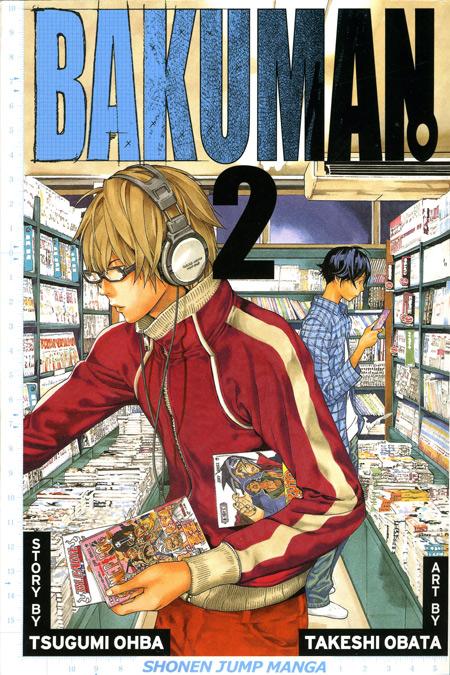
Bakuman: Volume 2: Chocolate and Akamaru

by Tsugumi Ohba (story) and Takeshi Obata (art), 194 pages

Moritaka and Akito get up the nerve to take their first work to Shueisha, the home of Jump and one of the country's biggest manga publishers.

Here the boys begin to better understand just what they've chosen to get themselves into. The harsh, highly competitive reality of the manga publishing world does have its share of rewards, but only for those strong--and lucky--enough to tough it out and roll with it. As the budding creators try to absorb all this new information about the major role of reader polls and internal office competition, they still have to deal with school and entrance exams and the ever complicated matters of the heart. Balancing all that out is going to be tough for the kiddos, but it makes fascinating reading for manga fans such as myself. :)

Sunday, August 21, 2011

A Drifting Life

by Yoshihiro Tatsumi, 834 pages

This hefty graphic autobiography recounts the youth and early career of a manga-ka coming of age in the years following the end of World War II. Hiroshi Katsumi--Tatsumi's stand-in self for the book--grows up avidly reading and drawing comics, trading books and ideas with his older brother Okimasa, and idolizing the now iconic Osamu Tezuka. The brothers save up for book binges and mail off submission after submission of their own works to popular magazines in the hopes of being published and getting their feet in the door of an industry still in its infancy. Over the years, they experience setbacks and triumphs, rivalries and teamwork, all in pursuit of a paycheck and their passion for good stories told with pictures.

Tatsumi, a trailblazer in Japanese alternative comics, hesitates to call his work "manga," often preferring the term "gekiga" in an attempt to convey his departures from mainstream story, tone, and format. His style is heavily cinematic, working within the parameters of lots of variously-sized rectangular frames, sometimes with no (or, conversely with tons of) dialogue or narration, therefore spreading the telling of a story out over more pages than was standard at the time. This boxy, long-form style gives him more in common with American comic books of the day rather than the freer form, minimalist manga of many of his peers. The communicating of this creative ambition to his employers and fellow artists takes up a portion of this autobiography, but he also focuses on the personal details of his and his family's struggles within the context of the ever-changing nation around them as the Japanese adjust to post-war then post-occupation existence, economic booms and busts, and wave after wave of Western influence.

I found this look into Japanese history and one man's life in the comics world to be engaging, enlightening, and engrossing (oh, alliteration, I love you). Don't let the book's brick-like nature or industry-specific focus intimidate you. I didn't recognize most of the authors and artists (with a very few exceptions) whom Tatsumi mentions and I still enjoyed it muchly. Many histories on manga focus on the greatness of Tezuka alone, overlooking contributions of other talented creators who also shared popularity and wide readership at the time. It's good to see that gap filled a little by Tatsumi's ten-plus-years-in-the-making memoir, which won the 13th Tezuka Osamu Cultural Prize in 2009 and, in the States, two Eisner Awards in 2010.

Sunday, June 26, 2011

Bakuman: Volume 1: Dreams and Reality

by Tsugumi Ohba (story) and Takeshi Obata (art), 204 pages

Fourteen-year-old Moritaka Mashiro loves to draw, but ever since his struggling manga-ka uncle's death, he has resigned himself to a boring future as an ordinary businessman. He studies, doodles sketches of the girl he secretly likes, and plods along through his days drained of all ambition. One afternoon, realizing he's forgotten his notebook--including his crushy doodles--in the classroom, he shuffles back to school to get it only to find it in the hands of his classmate, Akito Takagi...who refuses to return it until Moritaka agrees to be his partner in creating manga. The would-be artist drags his feet, but will talented Akito's enthusiasm--and enlistment of another future "partner"--be enough to motivate Moritaka to pick up his discarded dream and run with it? And if he does, will they succeed?

I've been looking forward to reading Bakuman, as it's the first team-up of these two creators since the perennially popular Death Note series (Obata also draws the award-winning Hikaru no Go series). This one again promises detailed, realistic art and slow-paced, talk-heavy plots, but without the super dark fantasy elements, instead focusing on all the nitty-gritty minutia of the process of creating manga, from the different kinds of pens used to the slim likelihood of being able to live comfortably off one's manga earnings. Right now, it's this backstage access to the industry's secrets that most intrigues me, as the characters, though fun and energetic, haven't made enough of an impression yet in this introductory volume for me to get too attached to them emotionally.