282 pages
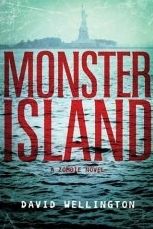
Only one month has passed since the virus broke out and zombie masses took over most of the developed world. Survivors have gathered in a few remote parts of the world. All that's keeping UN weapons inspector Dekalb going is his daughter, Sarah. They found temporary refuge in Somalia, but now he's forced to go on a dangerous mission in order to secure his daughter's safety. He's sent across the ocean to New York City, where he and a group of schoolgirls-turned-soldiers must find desperately needed medicine. But something unusual is happening in New York. A doctor figured out how to retain his human intelligence after death, so now there's a smart zombie out there. And though there's only one of him, he might be the one who ruins the whole mission.
This is a very well-done book. The premise sort of makes sense (which is good enough for a zombie novel, in my opinion) and is unique enough to stand out among all the typical stories of the undead that have become popular lately. I like the way the author made me think about what makes us human without being cliche or preachy. There's quite a bit of action but it's not super-gory, so it's one I'll recommend for people who don't like to hear all the blood-soaked details. It's definitely far-out (we're talking mummies coming back to life and immortal evil), but I thought it all fit together well rather than just being randomly thrown in. Monster Island is definitely going on my must-read zombie list.
Sunday, October 21, 2012
Saturday, October 20, 2012
"Dear Zari: The Secret Lives of the Women of Afghanistan" by Zarghuna Kargar
250 pages
This is a collection of stories gathered for "Afghan Women's Hour," a weekly BBC program that ran from 2005-2o12. Kargar, who grew up in Afghanistan before moving to the United Kingdom, used the connections she had there to find women with interesting, inspiring, and often heartbreaking stories and shared them on the program. There's a child bride given as payment to settle a family feud. One woman spent nearly every day of her life in a dark room weaving carpets. One girl was raised as a boy because her family couldn't handle the shame of being son-less. Many of the Afghan women women featured had to tell their stories anonymously because revealing their identities would endanger them.
I think I got a lot out of this book. I knew things were bad for women in Afghanistan, but hearing individuals' stories, in their own voices, made it really feel real. That many of these women were able to overcome such insane obstacles is a huge inspiration, and it makes me realize that if they can do that, I can do much more in my more secure environment. Their stories put my problems in perspective.
Wednesday, October 17, 2012
"Rip Tide (Dark Life #2)" by Kat Falls
320 pages
In this sequel to Dark Life, things have started to calm down in Ty's life. He no longer has to hide the Dark Gift--his ability to use sonar, like a dolphin--that he developed by growing up under the surface of the ocean. His friend/crush Gemma knows where her brother is, which is almost as good as being with him, and she's slowly starting to get used to life underwater. But then trouble finds Ty and Gemma again when they find an entire township chained to a sunken submarine, with its residents condemned to a watery death. This uncovers a mystery that is much bigger than it first appeared--and the stakes are higher than ever. It seems that everyone involved--the subsea settlers, the outlaws, the government officers, and a rival pioneer group--is poised for war, and Ty and Gemma don't know who to trust.
I love this series! The setting is so unique--it's futuristic and science fiction-ish, but it has a Wild West feel to it too. Ty and Gemma are charming and likable. I really like the pacing, too. There's plenty of action but you get some good character development weaved into the plot. I had a little more trouble following this one, but I still really got into it. I'm not sure how many are going to be in the series but I'm excited to read the rest!
Sunday, October 14, 2012
September stats and winners!
Hi everyone,
Here are our totals for September:
Books: 45
Pages:12,744
Most books
Jenny: 22
Heather: 12
Meggan: 11
Most pages
Jenny: 4634
Meggan: 4193
Heather: 3917
Most participation points
Jenny: 22
Heather: 12
Meggan: 11
Let's hit the books hard this month and get our stats up! Don't forget to tell your coworkers to join in on the fun :).
Heather
Saturday, October 13, 2012
"Change Anything: The New Science of Personal Success" by Kerry Patterson, Joseph Grenny, David Maxfield, Ron McMillan, Al Switzler
262 pages
Why do 95% of diet attempts fail? Why do New Year's Resolutions rarely last more than a few weeks or even days? Why is it just so hard to change bad habits? This book attempts to answer those questions and, more importantly, teach readers how to use the brain chemistry that creates bad habits to make good ones instead. The authors present six "sources of influence"--personal motivation (what we want and why); personal ability (our natural strengths and weaknesses); social motivation (how others' beliefs influence us); social ability (how the things other people do affect us); structural motivation (how things motivate us); and structural ability (how our environment affects us). There are strategies for putting each of these sources of influence to work to create good habits instead of bad ones.
I am usually skeptical of this kind of book, but I really got a lot of out this one. I even took some notes from it before returning it to the library. I like that it focuses on changing the way we react to our natural tendencies and things outside of our control instead of completely avoiding them altogether. It's a much more realistic approach. There are some things in here that I already knew, but I like the way they are phrased. For instance, every self-help book says not to beat yourself up for setbacks. This book says the same thing in a different way: "Turn bad moments into good data." The authors explain that without mistakes we would have nothing to learn from, and when we examine the slip-ups and learn from them, we are even better off than before we messed up. When you look at it that way, it makes mistakes seem almost helpful without accepting the behavior as a whole. There are lots of examples of these strategies being used for many specific aspects of life, such as weight loss, career improvement, friendship, etc. My only complaint is that there is more cheesiness than I like, though much less than most of the similar books I've read. Overall, though, this is a clear, well-organized book that gave me some motivation to take charge of my habits and routines.
Thursday, October 11, 2012
"Born Round: The Secret History of a Full-Time Eater" by Frank Bruni
368 pages
"Born round, you don't die square," Frank Bruni's grandma used to say. And Frank has always been round, literally. His huge Italian family revered food, so he had plenty of opportunities to feed his seemingly endless appetite. As he gained more and more weight, he became more and more stressed about his eating habits. He even began bingeing and purging as a twenty-something. Even though he eventually recovered from bulimia, he continued to struggle with his weight, especially during stressful times like when he came out as gay to his family. So it's no surprise that his family and friends were worried when he was named restaurant critic for the New York Times not long after he'd finally gotten his eating habits mostly under control. How would he maintain his progress when he made his living by eating?
There's not a lot of action in this memoir, and I felt like it's a bit too slow in parts. I felt like some of the repetition could have been edited out. However, "Born Round" has plenty of other good stuff going on. I like Frank's voice--he's humble and self-depreciating without being annoying about it, and he is good at making jokes about his situation without downplaying the seriousness of obesity and eating disorders. I also loved getting all the insights on the world of restaurant reviewing--super interesting. It's not a favorite, but I'm glad I read it.
Wednesday, October 10, 2012
"This Is Not a Test" by Courtney Summers
323 pages
The world is ending, but for Sloane Price, life has been over for a while. After her beloved sister left her alone with their abusive father, life wasn't exactly rosy. So when the dead start walking and civilization falls apart, Sloane accepts it as she has accepted all of her problems and waits for the dead to break through the barriers to reach her and the five other students holed up in what used to be their high school. Unlike Sloane, the other students actually want to live, and the only question is how far they will go to stay breathing. Before long, things start falling apart inside the school as much as outside and Sloane is forced to re-examine her decision to give up and let the others fend for themselves.
I like zombie books and apocalyptic fiction, as you've probably noticed if you've known me for very long, and this is one of the best that I've read recently. Yes, it's sort of predictable. When you've got some kids together in one building and some zombies outside, it's no shocker when things start going a little "Lord of the Flies." Still, it feels different than other stories with similar plots, more thoughtful and literary. I like the writing style--I'm not sure how to describe it other than to say that Summers definitely knows how to create a melancholy atmosphere and it fits the story perfectly. There's plenty of action, too, to move the story along. I feel like a lot of teen authors feel like they have to have a happy (or at least somewhat happy) ending and I like that Summers didn't do that here because it wouldn't have fit. I think it has a satisfying conclusion--it's not all sunshine and rainbows, but there's closure. Definitely a must-read for those who like end-of-the-world stories.
Subscribe to:
Posts (Atom)


