by Aron Ralston 354 p.
This is the biography of Aron Ralston, the man who cut his hand off when trapped by a boulder in a slot canyon in Canyonlands National Park, Utah. This is the same story the movie 127 Hours is based. It was an intense description of what he went through and interspersed with other nature experiences he had had before, most of which were other near death experiences. It was an interesting story and I learned some things I didn't know about the story from the news and interviews. One of the most interesting parts was not his first person account of his ordeal, but his third person account of the rescue effort by his parents, police, friends, and the states' and National Parks Service. I even recently spoke with a former park ranger who had a hand in the search for him, though that park ranger wasn't mentioned in this. Before the end of this book I knew I would not want to be friends with Ralston.
The cover was mostly blue.
Saturday, July 7, 2012

Friday, July 6, 2012
Becoming Sister Wives: The Story of an Unconventional Marriage
by Kody, Meri, Janelle, Christine, & Robyn Brown
271 pages
I am a big fan of the TLC show Sister Wives. I'm fascinated by polygamy, and the people who practice it. I could never be a polygamist, but I am curious about those who are. This book, written by the stars of the show, gives a more in depth look at the history of the family and the struggles they faced in order to create a successful polygamous family. I was surprised by some of the interpersonal issues described in the book because I did not pick up on them in the TV show. I had no idea that Meri and Janelle had such trouble getting along! I understand the jealousy issues these women faced, but I guess I never really thought about the dynamics of starting a polygamous family. Overall, this was an insightful read, especially for fans of the show.
271 pages
I am a big fan of the TLC show Sister Wives. I'm fascinated by polygamy, and the people who practice it. I could never be a polygamist, but I am curious about those who are. This book, written by the stars of the show, gives a more in depth look at the history of the family and the struggles they faced in order to create a successful polygamous family. I was surprised by some of the interpersonal issues described in the book because I did not pick up on them in the TV show. I had no idea that Meri and Janelle had such trouble getting along! I understand the jealousy issues these women faced, but I guess I never really thought about the dynamics of starting a polygamous family. Overall, this was an insightful read, especially for fans of the show.
Thursday, July 5, 2012
"Why Be Happy When You Could Be Normal?" by Jeannette Winterson

230 pages
In this funny but often heart-breaking memoir, Winterson recalls growing up in a Protestant fundamentalist home with her adopted parents. Nothing was ever good enough for her mother, who raged with untreated paranoia and anxiety disorder. Her father was more mild but didn't want to get between Jeannette and her mother, so she had no one on her side when her mom locked her out of the house or called her a devil child. When Jeannette grew older and realized she was a lesbian, things became even more strained between her and her parents, who believed that homosexuality is a sin. As an adult, she eventually began searching for her birth parents, and in the process learned to love herself and trust other people to love her too.
Jeannette has a very interesting story, but for some reason I couldn't get into it. The narratives and themes seem all over the place, so I had trouble following it. Winterson does a really good job of bringing individual scenes to life and making them feel real, like we're right there with her, but the whole thing as a whole could have been arranged better, I think. I also felt like the author tries to be funny at parts that aren't really that funny, at least to me (but, to be fair, my sense of humor is, um, unique). Despite these complaints, I did enjoy this story after a while. As I said, Jeannette certainly had an unusual upbringing. Though my family is not as conservative as Jeannette's, I did grow up in a Southern Baptist Church and knew people who reminded me of Jeannette's relatives. I think she does a good job of pointing out the idiosyncrasies of fundamentalism without being unfair or whiny.
Monday, July 2, 2012
"Blindness" by Jose Saramago
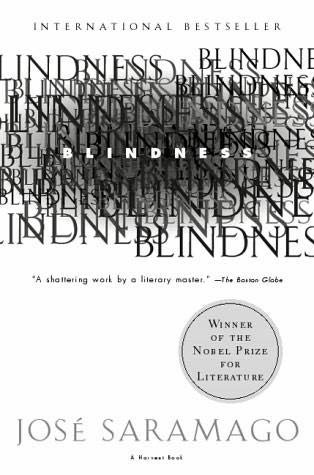
An epidemic of white blindness sweeps across an unnamed city. The panicked government quarantines the first victims in an abandoned mental hospital in an attempt to contain the outbreak. One woman pretends to be blind so she can stay with her husband. What they find in the quarantine is unspeakable. The victims are basically left to themselves, with only occasional food deliveries, and it doesn't take long for all social order to break down. Rape, assault, and all other forms of violence run rampant. Finally, the seeing woman decides to risk everything to lead her husband and five others out of the hospital. What they don't know is that the outside world has changed more than they could ever have imagined.
This is one of the most bizarre books I've ever read. I'll start with what I didn't like. First of all, the formatting nearly drove me insane. There is no punctuation and, even worse, no page breaks at all. Just line after line of endless text. It's exhausting to read because it's nearly impossible to keep track of who is talking and there is no break for the eyes. I suppose the author did it this way to make readers feel disoriented like the blind people or something, but it was so tiring and distracting that I almost didn't make it through the whole thing. Also, I'll be honest: I feel like I missed some of the deeper meanings. I mean, I get the illustration of how humans are so fickle and civilization is fragile, with all social order breaking down when things go wrong. I've heard this book described as a metaphor for "the horrors of the 20th century" and I didn't get that part (I hope I'm not making myself look too ignorant here; as a librarian, you'd think I'd be better at this sort of thing). Anyway, I did somehow get sucked into the story, despite all that. The idea of blindness being contagious is unique and totally creepy to me. I came to really care about the characters and I worried about what was going to happen to them. I would have liked more explanation at the end, but it was satisfying nonetheless. I recommend this one for people who enjoy analyzing metaphors (maybe they'll get more out of it than me!), as long as they can get past the annoying format.
Saturday, June 30, 2012
Arata, The Legend: Volume 9
 by Yuu Watase, 192 pages
Hinohara's infiltration of sho Kugura's territory gets complicated due to a too-successful disguise, and then things get much worse with the arrival of Kadowaki, who's set on making Kuguru submit to him.
I like the Hinohara storyline just fine (minus the hokey bits, which are admittedly many), but I seriously want to know what's going on in the normal world with Arata and Oribe and scary Harunawa. All we get here is a little portal-side chat between Arata and mopey Kotoha, who's trying to let go her crush on him. Is there just nothing happening over there? *sigh* And now we're going to have Mikusa, a warrior woman who lives as a man for clan security reasons, starting to look at Hinohara as her destined partner. The romantic melodrama just makes both her and Kotoha look a little foolish (in Kotoha's case, make that a lot).
Blue Exorcist: Volume 7

Rin's temper flare-up gets him the worst possible response from the Vatican...an execution order. But is Mephisto, the bearer of the bad news, actually telling Shura and the kids to break Rin out? If they're going to help Suguro's dad and stop a deadly epidemic, they'll have to do it fast.
Woo hoo, sneaky Mephisto. And we get to see Father Fujimoto's heart get a little nudge in the right direction in the previous volume's continued flashback. Bonds are strengthened and desperate measures taken as the younger generation pools its resources and prepares to fight evil. (That's what I like to see!) But now I'm worried for Rin's level-headed brother Yukio....
Blue Exorcist: Volume 6

Because he'd like to stay alive, Rin's on his best behavior as his classmates and fellow exorcists try to sniff out a rat in their midst before it's too late. Some of his friends are even starting to talk to him again, but when an angry Suguro yells at his father, Rin's memories of his own hurtful last words to his adoptive parent Father Fujimoto snap his control over his temper. His fiery remonstration of Suguro might do the other boy some good, but it also sets off alarms back at the zero-tolerance Vatican...
Flashbacks via a letter from Suguro's father to Rin begin to give us a little background on the old man's true motives and his fateful encounter with Father Fujimoto. And it's nice to see the family environment the other boys grew up in, as it adds a little more depth to their characters and the setting. Ah, siblings. So much fun (to annoy).
Subscribe to:
Posts (Atom)